
The Way Back
Is that even an option? Looking back to find a way ?

When I was a child, we had a typical suburban station wagon and these all had a Wayback seat. The wayback seat faced behind, not the way the car was heading. In the wayback seat, my siblings and I got to watch where we’d been recede into a thin ribbon of highway as if looking in the rear view mirror. We also got a clear view of other cars license plates, so we could play the game of who could spot the most different state plates in a given amount of time. We also reveled in seeing the truckers barreling towards us, perched high in their cabs, and pantomiming to them pulling on the string of their blasting horns, which most would cheerfully oblige by doing when they saw us. In between the wayback seat and the regular forward facing back seat, was a triangulated dead space, where the back of one seat didn’t quite touch the back of the other. Our family dubbed this this in-between seat. Mostly, on our long summer car trips, four kids and one or two parents, that seat went to me because I was the youngest and the smallest. I liked it. It was my private little boat. I could lie flat in it, coffin-like, and read or sleep . I could also sit up in it, buffered by my yellow windbreaker jacket and wadded up clothes, hum to myself, color and doodle stuff with my felt pens. The seat next to the driver ( always my Dad in those days) was the co-pilot seat, and the older kids felt the honor and responsibility to be in that seat. That was a serious seat. You had to not be goofing off or dozing in that seat. They all rotated fairly often. The co pilot literally held the map , spread out accordion- like on their lap, fanning out so big it also covered much of the view out the front window on that side. The map had super highways indicated by thick blue lines, the interstates with the red white and blue shield shape announcing the highway number. The state highways were thick pale yellow and then the snakey, thinner lines denoting the local roads. Our Dad would have already marked the route the night before with a bright red pen. He would gaily call out our ETA ( estimated time of arrival) as we went along, perhaps hoping to circumvent four kids wondering: are we almost there yet? The copilot or someone in the regular back seat would also be assigned to be the reader, so Dad wouldn’t fall asleep or get too bored as he drove. He preferred short stories and science fiction - tales from Robert Heinlein, Ray Bradbury, or Kurt Vonnegut. There were no earbuds or individual listening devices- we all listened to the same radio or to the short stories or tuned out and amused ourselves.
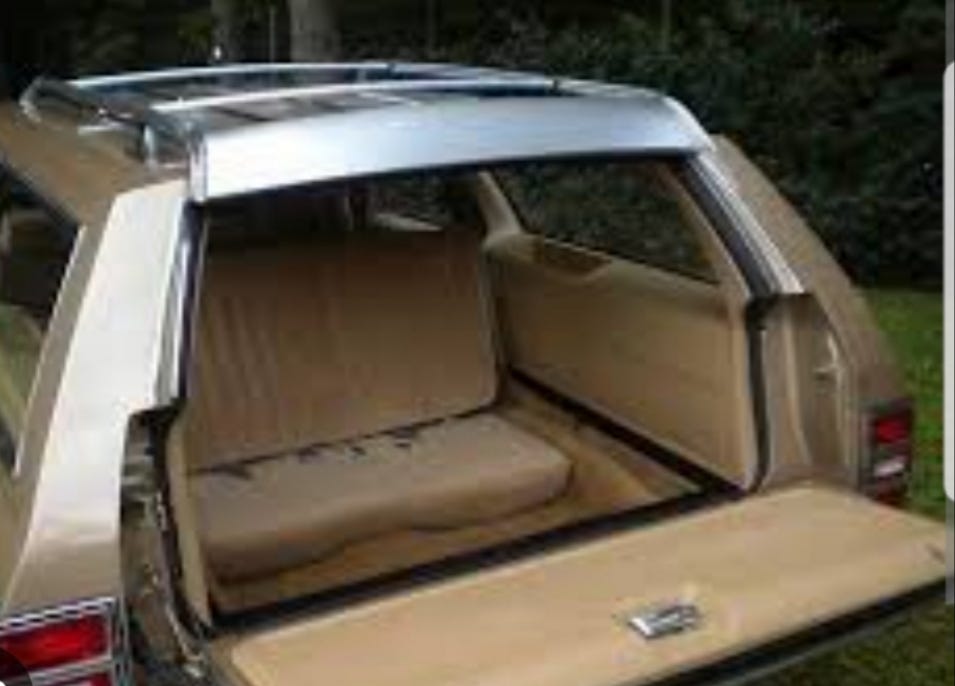
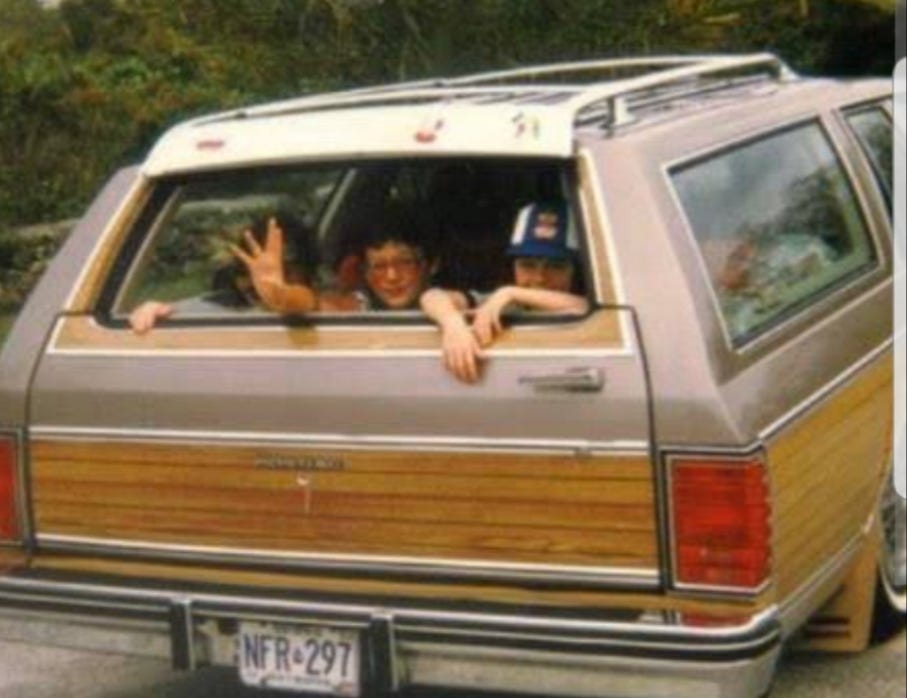
The wayback seat didn’t feel like you were seeing the past, really. We were moving so fast it was more like seeing the wake of a speedboat as you skimmed over the sea. But you definitely weren’t seeing the way you were heading. You weren’t seeing the way you even wanted to be heading ie: the big crinkly sounding map. Facing the way you just came, in a metaphorical sense, could be comforting. Facing where you are heading could seem endless: hopeless, even. Sitting in the in-between space hurt my neck if I tried to look forward or back too long, so it was literally like watching the world pass by from the sideview as I just sat there, wedged between what had come before me and not really getting the context or portent of what we were heading into. Being the youngest of four children that was a familiar feeling . Life mostly felt like that.
There’s that saying about those who don't know history being condemned to repeat it. I suppose it depends on just how far back into history one goes, because a lot of us as we get older seem to be looking off from the wayback seat and trying to either find our way from there or tell people all about how we got to where we are in contexts that seem to have receding relevance as we pass each shield shaped marker. On a broader scale, the earliest wayfinders- the navigators of seas and deserts relied on beacons from a very distant past-the stars, whose light has taken millions of years to arrive and yet is perfectly accurate for helping us to know both where we have been and where we are heading. The stars don’t have ulterior motives, though, or much interest in the squabbling kids in the back seat of a car on any given day, or any given tyrant of any country in any given century. The stars are interested in the big picture, the broad spaces, the wider themes.
When I was a teen in community college I took a car repair class; literally me, a dozen guys and a girl named Rocky. I took it because I had recently bought my first (used) car for five hundred dollars, and it seemed like knowing how to change the oil and sparks and what not would be a good thing. One of my roommates bought a 1949 Ford pick up and rented a “cherry picker” - some kind of big winch thing to take out the engine so we, the housemates, all worked on rebuilding the old engine. Later, my boyfriend and I bought two identical old vans for five hundred dollars apiece and used one for parts and fixed up the second as a little home on wheels. We traveled around the USA for nine months and through 48 states in it. Needless to say it broke down on the road— a lot. We used the Chilton’s automobile guide as the how-to for whatever needed patching up, and invested thirty five dollars in a triple A auto club membership for the times we needed towing to an auto parts store. ( Which was also- a lot)
What I’m saying: None of that under the hood or under the car savvy is left inside my brain now, and even if it was, it is as irrelevant as info stored on a 3 inch floppy disk. Cars run on computer chips and motherboards. I cant find my way forward by looking too closely back, although I am still unconvinced the long view isn’t of vital importance.
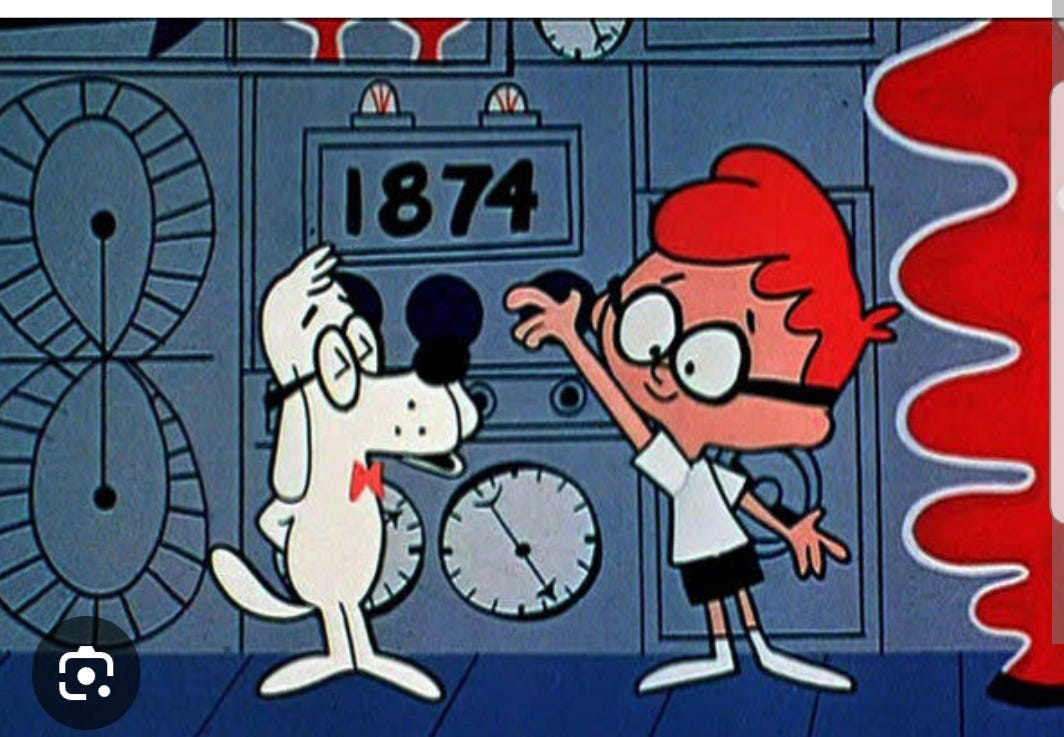
Recently I remembered this cartoon I used to watch as a kid- the Rocky and Bullwinkle show, which was actually a bit hard to follow because it had a lot of ironic jokes only the grown ups in the room would appreciate. But I remembered the Wayback machine- Mr. Peabody, a white hound dog in round glasses, and his adopted boy, Sherman, would take us to key moments or people in history by adjusting the dial on Mr. Peabody´s formidable time traveling machine, big as a room. In the five minute vignettes that followed, Mr. Peabody would be disappointed to see Edgar Allen Poe penning a book called “ Winnie the Pooh” and have to set history on its proper course by scaring him repeatedly, eventually by sending him his tax bill from the IRS, to get him to write his horror stories. He saved Beethoven from quitting composing and becoming a baker when he ran out of inspiration by telling him to go to the setting that would create the mood for what he wanted to write- only to find him sitting in the midst of traffic on Fifth and Madison avenue in New York to write his Fifth Symphony. Mr. Peabody and Sherman were shrewd inhabitants of the in-between seat in our station wagon, influencing both the past and the future from some rather cramped nether space between the times, one we all are trying to squeeze into comfortably, this space called Here and Now.
We understandably keep trying to form coalitions, change curriculums, enforce laws, elect officials, thinking by swapping someone new into the same old or slightly tweaked system something might change, but we also know all those structures, all the ways we knew how to organize ourselves, monetize things, communicate with one another and prepare our children are just sort of fizzling out like the wake at the back of the boat.
There is a modern Wayback machine- literally called this- ( at www.archive.org) which was founded in 2001 in the Bay Area and is keeping digital archives of all websites and pages since 1995 for free public access to web material that folded, was deleted, died away and in some cases, was censored by certain countries. This internet wayback machine was, in fact, named after Mr. Peabody the cartoon dog’s invention in the 1960’s- yet another sly reference to how history looks different and invites revision when revisited from the future. As of November, 2024, it says, the site has archived more than 916 billion webpages. In the long run, the founders note, “next to nothing” of it will survive in a useful way..as the format in which it was delivered will be all but unrecognizable”.
I have grown and teen grandchildren, and a grandbaby on the way. Right now the in between seat of life as it is, allows me to visit them in the car by listening to the computer generated voice on the Google maps app tell me where to go, what to look out for, and even to see the familiar thick blue and yellow lines on the palm sized square of my phone screen as if it was the paper fan that used to bloom out onto our front seat. A satellite I have never seen has pinned our car and destination down to such accuracy it sends me a photo of their front door sent from outer space. I see the delicate face of my unborn grandson on the same tiny screen in my palm as he floats inside my daughter’s body, before his own body is even finished forming. In the long run, we wonder, what will survive in a useful way?
How will we find our way, and to where, really are we even going? Are we looking at the future while sitting in the in-between seat? Battling over the narrative of the past by revisiting it now with Mr. Peabody, the dog with the bow tie and glasses’ wayback machine for revision? Should we ask the elders to go sit shotgun and put the young ones in the wayback seat so that can at least see the ground they just covered? Gen X, Gen Z, Gen Alpha…a generation used to span an entire lifetime and now it forms within a decade, zipping down the highway so fast the time frames through the windows are blurry and yet lulling.
Can we ever find our “way back” to anywhere or anyone? I suppose so, but to coin the cliché, we will never step in the same river twice so then again, no. A wayfinder is forging or discovering the way forward, even when to move forward we want to reference what, like the wake, propels us from behind. And this is different for many of us, this interpretative motive of propulsion.
I don’t think I’m alone in the in-between seat anymore, and I don’t think its age dependent this feeling of being unmoored yet trapped- both frustrated and impatient to get to where things make more sense or feel more defined while simultaneously feeling both relief and grief at all that’s drifting off in the rear view mirror. I have a sneaking suspicion even all these car metaphors are going to be outdated or obsolete before too long. Maybe its not even about the way forward or the way back anymore. I think this place in the now still eludes my understanding. So for now, we sit back, hold one another’s hands when we can, and feel what its like wherever we are- alive here now. In a body. In a time. Park the car. Get out of whatever seat you are in. Stretch your legs, breathe in deeply. Look around. See who and what is growing, living, dying around you. Sky still stretching wide canopy of stars, clouds, of blue or of grey above . Ground still holding your feet on board the planet. Planet still pirouetting at 1,000 miles and hour between moon and sun in a vast dark multitude of stars so far away we only see the echoes of their light from other times. Ah. Was there ever, I wonder, really a way back or a way forward then? Perhaps all of this supposes the linear model of time and space, which may be unraveling, forgetting there was always the spinning, the spiraling, the way through being the way around. The noticing where we are at any given moment, and the miraculous beauty of just that.
I couldn’t stop reading. Thank you
You coloring, doodling, humming. (Geeze, so cute).
What joy to imagine your spirit then as it is now, at home in the in between - your zone of interest, where your imagination and brilliance soars and shines…